
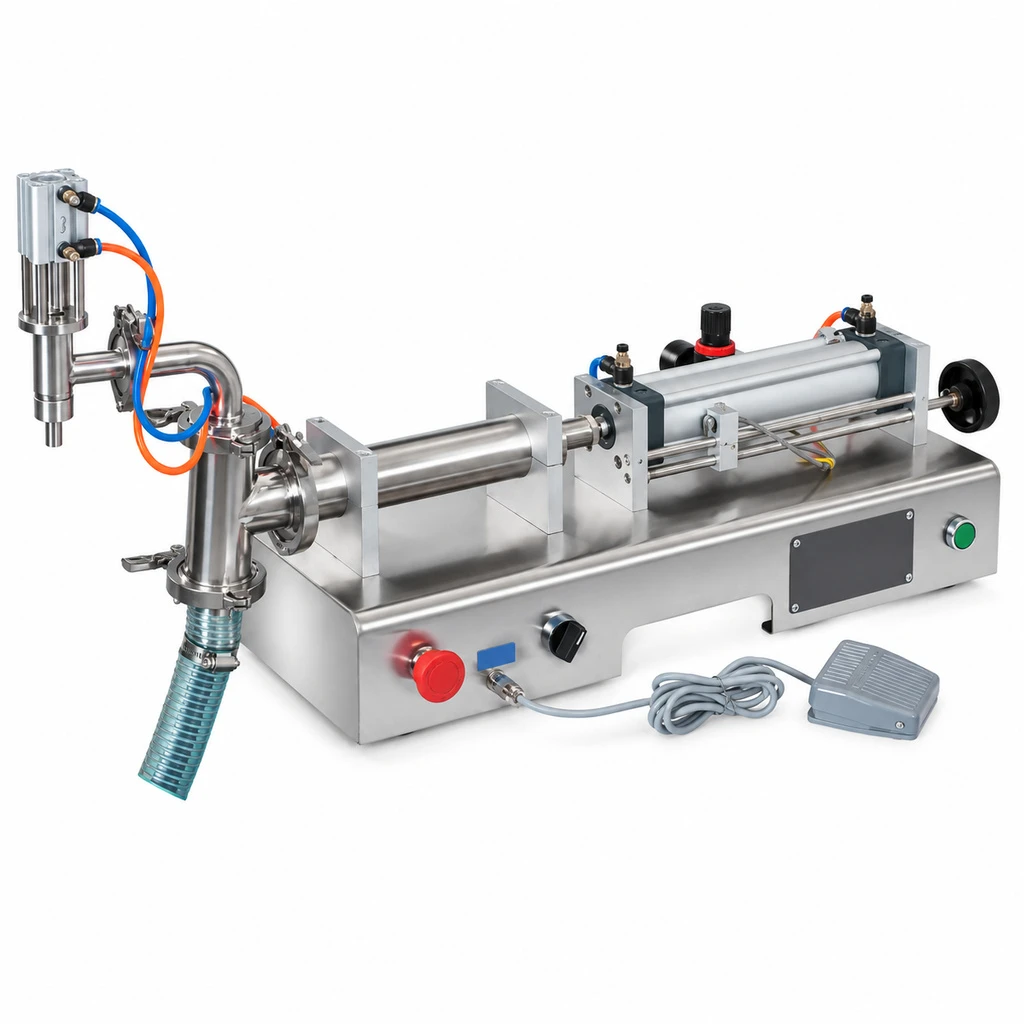
Equipment by application

Liquid & Paste Filling Machines

Compare liquid and paste filling equipment by viscosity, dose range, container, output and cleaning needs. Compare the models below and contact us for a configuration recommendation.

Selection before specification

Choosing the Right Machine

Choose a filling method around viscosity, particles, foaming, dose range and container opening—not the machine name alone.

Where this equipment family fits

  • Free-flowing liquids, viscous products and pastes after a material review
  • Bottles, jars and other stable containers in small or growing production
  • Single-machine filling or a future compact line

What we need to confirm

  1. Material viscosity, temperature, particles and foaming behavior
  2. Minimum and maximum fill amount plus acceptable test conditions
  3. Container dimensions, opening, stability and target output
  4. Contact material, cleaning method, voltage and compressed air

Selection guide

Key Selection Factors

Share your material, package and output target to narrow the configuration.

01

Material behavior

Record viscosity with temperature, particles, foam, stringing and chemical compatibility.

02

Dose and acceptance

State whether the dose is net weight (g/kg) or volume (mL/L), plus the minimum, normal and maximum fill. For mass-to-volume comparison, provide density at the filling temperature. Define accepted output and the test method.

03

Container interface

Provide actual containers, opening dimensions, stability and any drip-control boundary.

04

Cleaning and utilities

Confirm contact material, cleaning method, changeover, voltage and compressed air.

Supply boundary

What remains conditional

  • Pump or piston type is selected only after the material and dose are reviewed.
  • Speed and accuracy remain conditional on the agreed sample and test method.
  • Container handling, capping and labeling are separate stations unless the quotation includes them.

Common selection errors

Avoid a mismatched RFQ

  • Choosing only from a viscosity label without temperature or a real sample.
  • Comparing headline speed while ignoring refill, cleaning, rejects and operator work.
  • Assuming every wetted part or seal material is included in the standard configuration.

Procurement FAQ

Questions to settle before a quotation.

How do I choose a liquid or paste filling machine?

Compare the exact pump or piston, product-contact materials, dose control and cleaning method. Send viscosity at the filling temperature, particles or foam, container opening and target fill. Pump type alone does not establish compatibility; confirm the proposed configuration with representative material.

Can a published speed be treated as my production output?

No. Accepted output depends on the material, container handling, refill, rejects, changeover and the agreed test window. Define those conditions before comparing models.

What samples should I provide?

Provide representative material and the actual container or dimensioned samples. Include the expected temperature, fill range, cap or closure and cleaning requirement.

Configuration input

Send the material, package and accepted-output target.

Our team will use these details to recommend equipment for your application.